

Responsible gambling: keeping play a choice
Gambling is entertainment that costs money, with a real risk of loss — never a source of income. This page sets out a practical plan, the signs that play is slipping out of control, the account tools PLAYDASH provides and where to find help outside the casino.

Set your limits before you play
Boundaries hold best when they are decided calmly in advance, not in the middle of a session.
Controlled play starts before the first spin or bet. The money you use is separate from rent, food, bills, savings and debt repayments, and the time is planned rather than open-ended. A loss can still be disappointing, but it does not create a need to win it back straight away.
What your plan should cover
A simple plan covers:
- a fixed entertainment budget you would accept losing in full;
- a maximum session length, with a timer if that helps;
- a stake limit for a single round or bet;
- how often you allow yourself to deposit;
- the point at which you stop, win or lose;
- when you will take a longer break.
Never use borrowed money, never top up a budget that has already gone, and never raise the next stake to recover an earlier loss. Results are independent: a losing round does not make the next one more likely to win. Bonuses and high-RTP games do not remove that risk either, and fast formats such as instant games can make spending harder to notice.
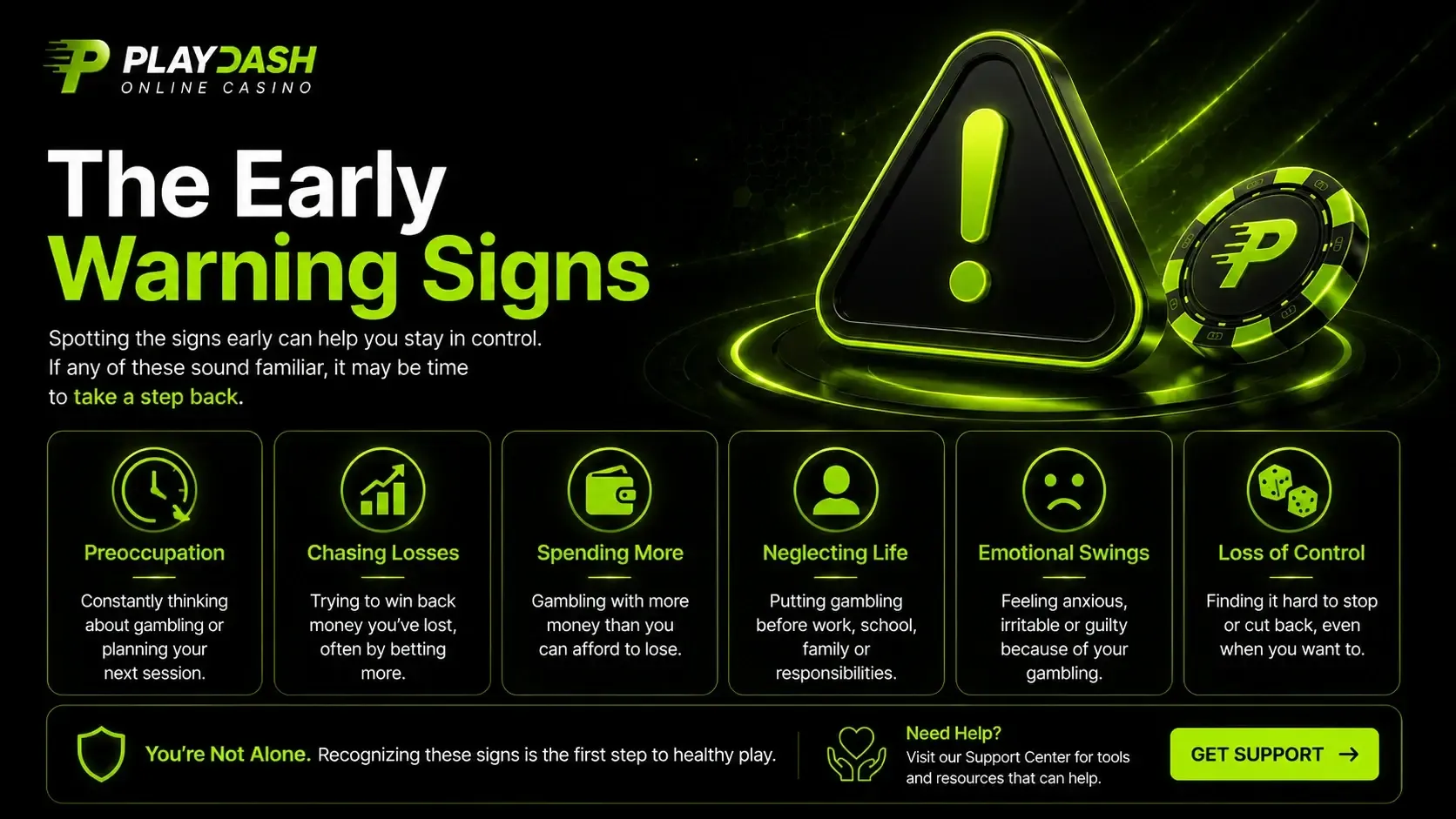
Recognising the warning signs
One bad session proves little. What matters is a pattern that keeps repeating.
| Area | What to watch for |
|---|---|
| Money | Bets creeping up, deposits becoming larger or more frequent, chasing losses, playing with borrowed money |
| Time | Sessions running past the planned stop, sleep, work or plans slipping |
| Mood | Irritation when unable to play, anxiety about losses, guilt afterwards, playing to escape stress |
| Secrecy | Hiding deposits, losses or session length from people close to you |
A regular self-check
A useful habit is to compare the time and money you meant to spend over the last week with what you actually spent; the transaction history in your account makes this easy. If several signs appear together — especially chasing losses, secrecy and repeated broken limits — the pattern is no longer just entertainment, and it is time to use firmer tools.
Making the plan stick
Plans fail most often in the middle of a session, when excitement or frustration moves the line. A few practical habits help them hold:
- set a phone timer for the session length before opening the lobby;
- decide your stake per round in advance and do not change it to “win back” a loss;
- treat the budget as spent the moment you deposit it, not as money you might recover;
- avoid playing when tired, upset, after drinking or to escape a bad day;
- take regular breaks away from the screen, especially with fast instant games;
- review your transaction history once a week and compare it with your plan.
Bonuses deserve a special mention. A promotion with a wagering requirement can quietly encourage you to keep playing beyond your plan in order to “finish” it. You are never obliged to complete a bonus; stopping at your limit is always the right call.
Account tools and when to use them
PLAYDASH accounts include deposit limits, cooling-off periods and self-exclusion. Each fits a different moment.
-
Deposit limit
A ceiling on how much can be added, set in the account profile. Useful when spending is starting to creep up but other boundaries still hold.
-
Cooling-off
A temporary break that stops access for a defined period. Useful when a session feels as if it has run away from you.
-
Self-exclusion
A longer break for a fixed period or indefinitely, arranged through support. Useful when limits and short breaks are no longer enough.
For the period of a self-exclusion, betting and deposits are blocked and opening a new account to get around it is not allowed. Final settlement of open bets and the balance happens before the account closes, and once the period has begun it cannot be shortened — a deliberate protection against an impulsive return. Any return afterwards is at the operator’s discretion and is handled through support rather than switching back on automatically.
Before requesting self-exclusion, ask support which lengths are available, whether account history stays reachable during the break and what happens to any active bonus. Choosing a period with room to spare usually works better than picking the shortest one.
When the platform steps in
Responsible gambling is not only a button you press. Under its terms, the operator may notice signs of risk — for example a pattern of regular losses or distressed messages to support — and open a conversation about limits, or restrict or close an account. Activated limits and self-exclusion are enforced by the platform.
No fixed public rule such as “a certain number of losses triggers exclusion” is described, so an intervention should be understood as an account-protection measure rather than a penalty. Real-money play on Singapore accounts is for players aged 21 and over, and age is checked during verification.
Support outside the casino
Account controls restrict access; they cannot replace support from people.
You can tell someone you trust what is happening and ask for support with your spending plan. You can also contact an independent support service; you do not need to choose between support from people close to you and professional help.
Independent organisations also offer free, confidential help:
- Gambling Therapy — online support with confidential text-based live help, peer groups and multilingual assistance;
- Gamblers Anonymous — peer support meetings, including virtual and telephone options;
- local healthcare or counselling services in Singapore — check the current options available to you rather than relying on an old listing.
You do not need to wait until every warning sign appears. The first signs are already a reasonable point to pause, reduce access and talk to someone.
Questions
Can I shorten a self-exclusion once it has started?
No. A self-exclusion period cannot be shortened once it begins, and any later return is at the operator’s discretion.
Where do I set a deposit limit?
Deposit limits are set in the account profile. Cooling-off and self-exclusion are arranged through the account or support.
Can I open another account during self-exclusion?
No. Creating a new account to get around an exclusion is not allowed and undermines the protection.
What should I ask support before self-excluding?
Ask which lengths are available, whether you can still see your account history during the break, and what happens to any active bonus or open bets.
Is it a problem if I only lose occasionally?
Losing is a normal part of gambling. What matters is the pattern: chasing losses, rising deposits, secrecy and broken limits that keep repeating are the signs to act on.
The core rule
Keep gambling as entertainment funded only with money you can afford to lose. Do not chase losses, do not play with borrowed money, and do not let a limit set before a session become a negotiation once it has started. If that has already become difficult, use the account tools and reach out for support — taking a break is a strong decision, not a defeat.